
Table of Contents
I didn’t write this for sympathy. I wrote it for you—the boy I used to be. The one who didn’t fall apart, but didn’t feel whole either. The one who thought being strong meant being silent, and that asking for help was weakness.
You weren’t just a kid. You were a kid in survival mode. And no one told you that wasn’t normal.
If I could go back, I wouldn’t try to fix everything. I’d just sit beside you. Let you know you’re not invisible. That someone sees how heavy it all is. That you didn’t deserve the pain you carried, and it was never your job to keep the family from falling apart.
You thought silence made you a man. But what you really needed was rest. Permission to be a kid. To cry. To play. To not always be on alert.
This post is for you—and for every man still carrying the boy inside. Because inner child healing for men doesn’t start with fixing the past. It starts with facing it. Gently. Honestly. And with hope.
If you want a deeper look at what it really means to start healing from your past, I share more of my journey in this post about overcoming childhood trauma as a Christian man.
I Thought It Was Just Life
Back then, I didn’t know what trauma was. Or emotional neglect. Or survival mode. I just thought some kids had peace and others had chaos—and I figured I landed in the second group.
We moved constantly. Yelling was normal. Fear was part of the furniture. I got quiet at sleepovers—not because I was shy, but because I was afraid of doing something wrong. I saw how other families lived and knew mine wasn’t like that, but I couldn’t explain it.
I thought numbness was maturity. That bracing for impact was what growing up meant.
But now I know: that wasn’t just life. That was a nervous system trained by fear. That was a kid building walls for protection. That was the beginning of emotional disconnection that would follow me into adulthood.
And this is why inner child healing for men matters so much—because most of us don’t realize we’re wounded until the damage shows up in how we relate, how we react, and how we shut down.
What I thought was “just life” was actually the moment I began learning to disappear. To detach. To survive in silence.
But no kid should have to learn that.
The Year Everything Fell Apart
Seventh grade isn’t supposed to be the year your world collapses. It’s supposed to be about lockers, awkward school dances, and figuring out who you are. But for me, it was the year everything broke.
My mom left—said she was going to Florida to get things ready for us. But weeks turned into months. The plan never settled. Then came the moment that changed everything: my sister was assaulted. My dad, passed out in the next room, was arrested. My siblings were taken by the state. My sister was adopted out of the family. And I was sent to live with my grandma.
It all happened fast—but internally, I aged ten years in a matter of weeks.
One day, I was just a kid in a chaotic home. The next, I was the last one standing. Displaced. Alone. Pretending I was okay because I thought that’s what strong people did. No one explained what was happening. No one asked how I was doing. So I stopped asking, too.
I did my homework. Went to school. Smiled when I needed to. I played the part. But inside, I was unraveling. Scared. Angry. Terrified that if I made one wrong move, everything would fall apart again—and somehow, I believed it was my job to keep it together.
This is the kind of pressure so many men carry silently. And it’s why inner child healing for men is so vital. Because so many of us never got the chance to grieve the wreckage—we just adjusted.
The Weight Boys Carry That Becomes Adult Burden
I didn’t know the term “parentified child” back then. I just knew I had to grow up fast.
Adults praised me for being mature, calm, and responsible. But behind that praise was a painful truth: I didn’t feel like I had a choice. Someone had to be steady. Someone had to hold it all together. And without ever being told, I decided that someone was me.
I didn’t just carry my own emotions. I carried everyone else’s, too. My siblings. My mom. The entire family system. I became the peacekeeper. The fixer. The one who believed that if I just stayed “good” and didn’t need too much, maybe I could keep the next crisis from happening.
But that weight wasn’t mine to carry. I was just a kid.
And here’s what happens when boys carry that kind of weight too early: they grow up into men who don’t know how to rest. Men who feel guilty for slowing down. Men who think their worth is tied to how much they can carry.
This is why inner child healing for men matters so deeply. Because the pressure to perform, to protect, to fix—it doesn’t go away with age. It becomes identity. Until you name it. Face it. And finally, begin to let it go.
You weren’t made to carry everything. You were made to be cared for, too.
Where Was God in My Childhood Trauma?
By the time life really started unraveling, I already believed in God. I had been saved. Baptized. I knew the verses. I knew the prayers. I knew the “right” answers.
But when my world collapsed—when I was separated from my siblings, when my mom was gone, when my dad was arrested and my sister was assaulted—God felt silent. And I didn’t know what to do with that silence.

I didn’t walk away from faith. I didn’t curse God or denounce anything. I just… distanced myself. Not out of rebellion—but out of disappointment.
If someone had told me back then, “God’s going to use this,” I would’ve shut down. I didn’t want purpose. I wanted peace. I didn’t want redemption. I wanted a normal life. And if God was letting all of this happen, then I wasn’t interested in His plan.
So I leaned into self-reliance. I stopped praying. I stopped asking. I stopped expecting anything from God—because needing Him felt like setting myself up for more hurt.
That distance? It lingered for years.
And this is the part most men won’t say out loud: sometimes faith wounds you quietly. Not because God isn’t good, but because we haven’t healed the places where we felt abandoned.
That’s why inner child healing for men can’t be separated from spiritual healing. Because real faith doesn’t ignore the questions—it brings them into the light and lets God meet us there.
Why No One Noticed My Inner Child Was Hurting
Nobody asked what was going on inside me. Not because they didn’t care—but because I didn’t show it.
I was the quiet kid. The polite kid. The one who didn’t make waves.
And that made me invisible.
My grandma gave me stability. A roof. Routines. She loved me. But like so many from her generation, love was measured by provision. If I was eating, going to school, staying out of trouble—I was “fine.”
But I wasn’t fine. I was just quiet.
I was surviving in silence, carrying pain I didn’t have language for. The tight chest. The sense of being on edge all the time. The blank stare I wore like armor. I thought all of that was normal.
No one told me that what I was feeling had names: trauma, anxiety, hypervigilance, numbness.
And when you grow up thinking your silence is strength, you never learn how to ask for help.
This is why inner child healing for men is so powerful. Because a lot of us never learned how to be seen. We were rewarded for not being a problem. For staying composed. For not needing anything.
But healing starts when you realize: you shouldn’t have had to disappear to feel safe.
And the boy you used to be? He didn’t need someone to fix him. He needed someone to notice him.
What Visiting Normal Families Taught Me About My Childhood
I’ll never forget one sleepover—just a few houses down from my grandparents’ place, but it felt like another planet.
The house smelled clean. The pantry was full. The parents were playful, not unpredictable. There wasn’t tension in the air or chaos waiting to erupt. There were no slammed doors. No yelling from the other room. No one passed out on the couch. Just… calm.
It messed with me.
I sat there—quiet, polite, careful. Not because I was naturally well-mannered, but because I was afraid. Afraid of messing something up. Afraid of being a burden. Afraid of doing anything that might make me feel unsafe.
I watched the other kids be loud and carefree, wondering how they weren’t constantly scanning the room for signs of danger. I didn’t understand how they could laugh so easily or run through the house without flinching when their dad raised his voice to call for dinner.
That was the first time I realized my life wasn’t normal.
It wasn’t maturity that made me act that way. It was fear. And I had gotten really good at hiding it.
These moments—small, seemingly harmless—become turning points in inner child healing for men. Because sometimes, all it takes is seeing peace in someone else’s home to realize how much you’re still bracing for impact in your own.
What I Wish I Could Tell Him
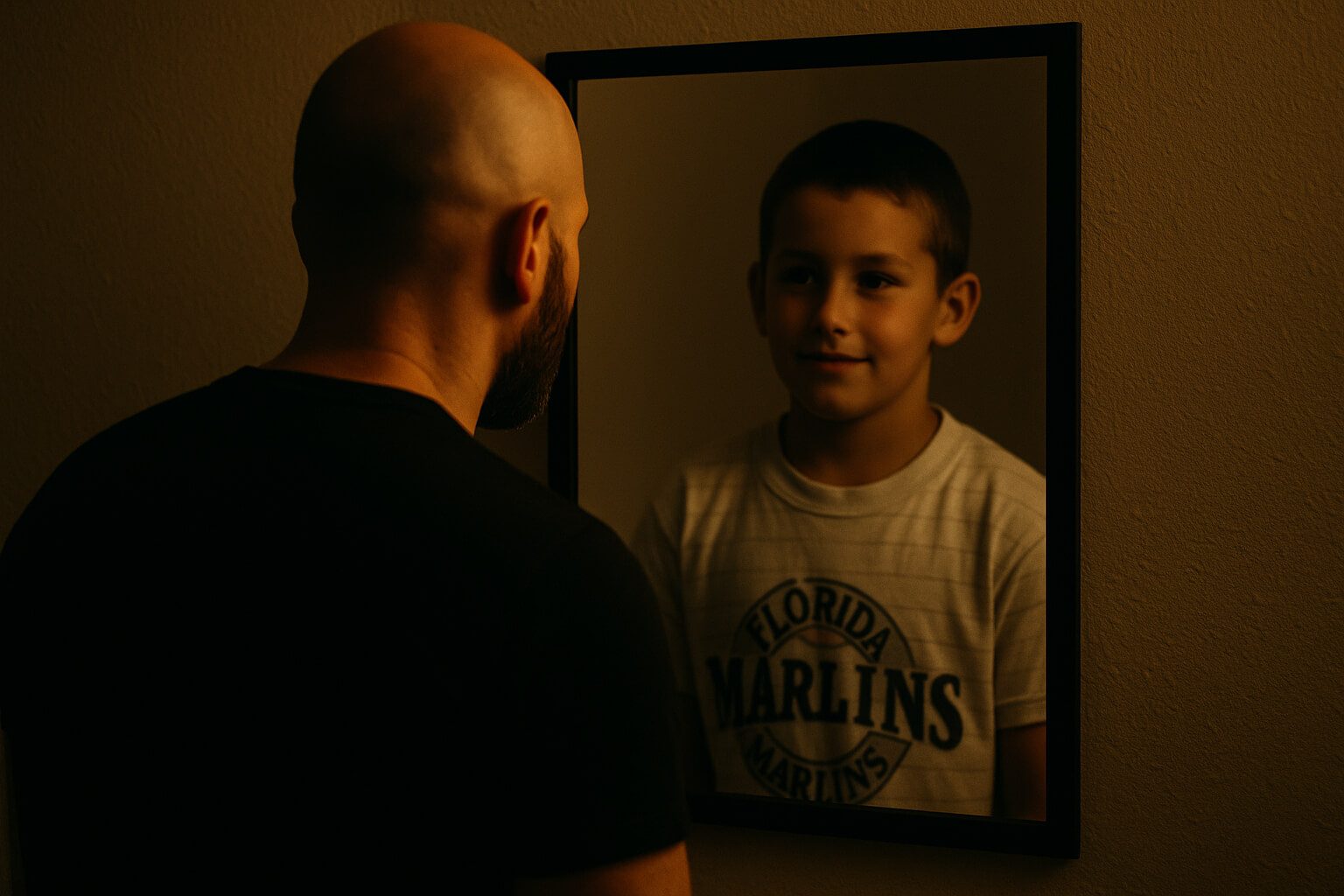
If I could sit across from my seventh-grade self—the version of me standing in the rubble of a broken home—I wouldn’t try to give him advice.
I’d just tell him: You’re not crazy. You’re not broken. You’re just carrying way more than a kid ever should.
I’d tell him that the fear, the pressure, the guilt? None of it is his fault. That holding it all together doesn’t make him strong—it makes him exhausted. And that shutting down might have worked for a while, but eventually, it’s going to keep him from feeling anything real.
I’d tell him something he never heard growing up: It’s okay to ask for help. It’s okay to cry. It’s okay to not be okay.
Because that’s where healing begins.
And maybe more than anything, I’d tell him this: God hasn’t abandoned you.
Even when it feels like no one’s listening. Even when it seems like He’s a million miles away—He’s not. He sees you. He’s with you. And He isn’t waiting for you to “man up” or prove anything. He loves you now. In the mess. In the silence. In the survival.
That’s the truth I wish I’d known sooner—and the one I’m hoping every man carrying a wounded inner child can start to believe, too.
Realizing My Childhood Wasn’t Normal
For most of my life, I thought the pain was my fault.
I figured I was just too sensitive. Too emotional. Too weak to handle what everyone else seemed to survive just fine. I told myself I should be tougher. That if I was struggling, it must’ve been because I wasn’t built right.
But now I know the truth: it hurt because it wasn’t normal.
It wasn’t normal to walk on eggshells around your parents. It wasn’t normal to wonder if your mom would come back—or if your siblings would be taken away. It wasn’t normal to feel like the only way to stay safe was to stay silent.
You weren’t being dramatic. You were adapting. That’s what kids do when the people who are supposed to protect them are the ones they have to protect themselves from.
You didn’t cry because there was no room for tears. You didn’t ask for help because no one showed you it was safe to do so. And that’s not weakness—that’s survival.
Inner child healing for men starts here: by admitting that what we went through wasn’t just “a rough childhood.” It was trauma. And the hurt we’ve carried into adulthood isn’t proof that we’re broken—it’s proof that we’ve endured.
You weren’t too sensitive. You were too unsupported.
And the kid inside you—the one still bracing for impact, still trying to stay small, still wondering if any of this is okay to feel—he doesn’t need you to toughen up. He needs you to tell him: You were never the problem.
When I Started Telling the Truth
I was in high school when I finally said it out loud: “Do you remember when I was choked with a jump rope?”
It had been more than a decade since it happened. But the memory had never left. It was there—quiet, heavy, sitting in the back of my mind without language or validation. I didn’t even know if it was real.
My mom was shocked. She hadn’t known. She’d been told a different version of the story. But instead of brushing me off or defending the past, she got emotional. She listened. She apologized. And that changed something in me.
It didn’t erase the memory. But it made it feel less like mine alone.
That was the beginning of my honesty—not just with my mom, but with myself. I started acknowledging other moments I had minimized. I started letting myself admit: Yes, that happened. And yes, it hurt.
That’s a critical part of inner child healing for men—learning to tell the truth, even if it’s messy. Even if it’s decades late. Because until we name the pain, we can’t heal it.
Every time I gave voice to something I used to bury, the shame lost a little of its grip. The silence got quieter. And the healing got louder.
Not because the story changed—but because I finally stopped hiding it.
Inner Strength Comes from Facing Childhood Trauma
I used to think strength meant silence.
No tears. No questions. No weakness. Just grit your teeth, hold your breath, and push through it.
That’s what I saw. That’s what I learned. And that’s the version of strength I tried to live up to—one that kept everything buried, everything locked down, everything behind a wall I thought made me tough.
But here’s what I know now: that wasn’t strength. That was survival.
Real strength—the kind that brings actual healing—isn’t about pretending it doesn’t hurt. It’s about staying soft when life tries to harden you. It’s about being honest with yourself and others. It’s about feeling the weight of what you’ve carried and still choosing to stay in the moment instead of disappearing from it.
Inner child healing for men means redefining strength.
It means realizing that letting someone in doesn’t make you weak—it makes you human. That being able to cry, to ask for help, to say “this still affects me” takes far more courage than pretending you’re fine ever did.
I didn’t always recognize it, but I had that kind of strength in me all along. It just got buried under years of self-protection. And now? God’s not asking me to fake it. He’s helping me find what was hidden beneath all the coping.
The strength I thought I didn’t have was never gone.
It was just waiting to be reclaimed.
What I Know Now
If I could sit across from that seventh-grade version of me—the one who felt like the world had just collapsed—I wouldn’t try to clean up the story. I wouldn’t promise him everything will be easy. Because it won’t be.
But I would look him in the eyes and tell him something simple:
You don’t have to carry this alone anymore.
That’s what inner child healing for men really looks like.
It’s not about erasing the pain. It’s about recognizing that God was there through every part of it. That none of those dark, quiet moments were wasted. That the silence, the shame, the fear—they didn’t disqualify you. They were shaping you.
I used to think healing would mean the memories stopped hurting. But now I understand—healing means the pain stops owning you. It becomes something you can hold with open hands. Something that informs how you love, how you lead, how you show up for the people around you.
And maybe most importantly:
You weren’t broken. You were being built.
Built into someone who knows how to stand in a storm.
Someone who can sit with another man in his grief and say, “Me too.”
Someone who leads with presence, not performance.
That’s what I know now.
And that’s what I want you to know too.
You’re Not Alone in This
If you see yourself in that seventh-grade version of me—the quiet kid carrying too much, trying too hard, afraid to fall apart—I want you to hear this loud and clear: you are not alone.
You’re not too broken to be healed. You’re not weak for feeling what you feel. You’re not crazy for wondering if anyone sees you, notices you, or would care if you stopped showing up.
I’ve been there. I know the silence. I know the ache.
But you don’t have to keep carrying it by yourself.
God sees you. Even if you don’t feel Him right now. Even if you’ve got questions, anger, or years of distance built up. He hasn’t turned away. He hasn’t given up. And He hasn’t wasted a single page of your story.
But now, this is what the Lord says—
he who created you, Jacob,
he who formed you, Israel:
Do not fear, for I have redeemed you;
I have summoned you by name; you are mine.
That pain you’ve lived through—the weight you never asked for—it doesn’t get the final say. It might still sting. It might still be raw. But it can be repurposed. Redeemed. Used.
Not just for survival, but for something more.
You don’t need to be perfect to be loved. You don’t need to be whole to be seen.
You just need to keep going.
You’re not alone. You never were.
And what’s ahead is greater than what’s behind—because God’s not done with you yet.
If this hit home for you, stay connected.
I write for men like us—the ones trying to heal, lead, and build something better without pretending it’s easy.
Join my email list below and get honest stories, real encouragement, and faith-driven reminders that you’re not in this fight alone.
👉 Sign up here to get the next one.
You’re not crazy. You’re not weak. You’re not the only one.
Let’s keep going—together.



0 Comments