
Table of Contents
The Break I Thought I Needed
I was still a kid—between seventh and eighth grade—but I didn’t feel like one. At that point in my life, I was already the stand-in parent. My mom was in Florida, and I was living in Tennessee with my dad, my brothers, and my sister. I wasn’t just watching cartoons and riding bikes—I was watching over people. Changing diapers. Doing laundry and dishes. Making sure my siblings were safe, because no one else really was.
So when the chance came to take a trip to New York with my granddad, I jumped at it. I needed to breathe. I needed to be somewhere I wasn’t in charge of anyone. I didn’t feel guilty—at least not yet. I just wanted a break from the constant weight of responsibility.
These trips were something we did often. We’d drive up to visit his son—my uncle by marriage—and I’d get to hang out with cousins, swim in their backyard pool, maybe race bikes or sleep in a tent. It wasn’t extravagant. But it was a different world. I could be a kid again, even just for a little while.
I don’t remember everything we did that summer. Honestly, most of it’s a blur now. But I do remember the feeling: lighter air. Fewer expectations. No little kids crying in the next room. No tension waiting behind every closed door. It wasn’t paradise—but it was peace.
And yeah—I missed my brothers and sister. I wished they could’ve come. But this wasn’t goodbye. It wasn’t abandonment. I told myself this was just a short trip, a reset. I’d be back soon. Everything would be okay.
That’s what I told myself.
But when your family falls apart, sometimes the unraveling starts when you’re not looking. And by the time I came home, the damage was already done.
When Your Family Falls Apart Starts With a Phone Call
Everything changed with a single sentence.
“We have to go home early. Your dad got arrested.”
Just like that, the air shifted. The weight I’d left behind in Tennessee came rushing back before I could even brace for it. I don’t remember where we were—maybe sitting in the car, maybe packing up our things—but I remember the tone in my granddad’s voice. Firm. Final. And a little bitter.
He wasn’t my biological grandfather—he met my grandma the week I was born—but he’d always been there. And he never liked my dad much. Maybe it was something personal. Or maybe he just saw things I hadn’t wanted to admit yet. Either way, there was no softness in the way he told me. No space for questions. Just: it happened. We’re going back.
And the fear hit almost immediately.
I didn’t know why my dad got arrested. I didn’t know what it meant for my brothers or sister—or for me. I didn’t even know what I was coming home to. But I knew one thing for sure: it wasn’t going to be good.
This wasn’t the first time things had gone sideways. But this time felt different. Heavier. I could feel it in my granddad’s silence. In the urgency of the early departure. In the knot that formed in my chest and wouldn’t let go.
When your family falls apart, it doesn’t always look like an explosion. Sometimes it sounds like a quiet car ride home, with no one willing to say what’s coming next.
And deep down, I knew—I wasn’t ready for it.
Relearning What Was Normal
At some point on the drive home—or maybe it was after we got back—I found out what happened.
Child neglect.
That was the charge. That’s why my dad got arrested. But at the time, the phrase didn’t really compute. I didn’t feel neglected—not in the way you picture when you hear that word.
We had food. I mean, toast and water counted, didn’t it? We had clothes—though we washed them in the kitchen sink and dried them out on the wooden fence. We weren’t getting hit. We weren’t running the streets. So how could it be neglect?
But as we got closer to home, things started clicking into place. Like how we were locked outside most of the day—not to play, not to get sunshine, but so my dad could drink or disappear. Like how my sister—who couldn’t talk, couldn’t feed herself, couldn’t even tell you if she was in pain—was left alone in her crib, crying. A lot.
And the house? It didn’t feel like home. It felt like a waiting room. Somewhere you existed until the next thing happened.
There was no bedtime. No stories. No supervision. Just scattered moments and long stretches of silence.
When your family falls apart, it doesn’t always come with broken windows or shouting matches. Sometimes it crumbles quietly. One overlooked moment at a time.
I had called it survival. I thought it was just how life worked when money was tight or when grown-ups were tired. But now, someone had put a name to it—and that name was “neglect.”
I wasn’t just tired. I was worn thin from carrying things a kid was never meant to carry.
And I hadn’t even realized I was breaking.
The Truth About What Happened
The truth was worse than anything I could’ve imagined.
While my dad was passed out—drunk, high, maybe both—our neighbor came into the house and assaulted my sister.
My sister, who couldn’t speak. Who couldn’t fight back. Who couldn’t even tell someone she was in pain. She had Cri du chat syndrome, a rare condition that made her almost completely dependent. She spent most of her time in a crib, waiting on someone to care. Waiting on someone to protect her.
No one did.
My brothers were locked outside. Not because it was good for them, or because they were playing. That was the daily routine. When your dad doesn’t want to deal with you, you get sent outside. All day. Every day. Whether it’s hot or raining or you’re bored out of your mind. You stay out.
That’s what we were used to. That’s what we called “normal.”
And when your family falls apart, you don’t always notice it’s happening. Because sometimes, it falls piece by piece, and you’re too close to see the cracks.
I still don’t know who called the police. Maybe it was my dad—once he sobered up and saw what had happened. Maybe it was a neighbor who heard the crying. Maybe it was someone sent by God to break the silence. But eventually, help came.
And it wasn’t a trained counselor who comforted my sister. It was my brother. A fifth grader.
He saw the blood. The towels. The aftermath. And he held her.
And me?
I wasn’t there.
I was in New York. Sleeping in a tent. Swimming in a pool. For once, I was just being a kid. For once, I’d put down the weight.
And that’s when everything broke.
When your family falls apart, it doesn’t wait until you’re ready. It doesn’t pause just because you took a breath.
I’ve never fully forgiven myself for not being there.
Even though I know—I was just a kid too.
Guilt Is a Twisted Mirror
I didn’t cause it.
But I couldn’t stop it.
And somehow, that hurt worse.
That’s the thing about guilt—it doesn’t follow logic. It doesn’t care that you were just a kid. It doesn’t care that you didn’t know. It doesn’t even care that when your family falls apart, it’s never the child’s fault. Guilt doesn’t care. It just fixates on one thing: You weren’t there.
And it plays that scene on repeat—burning it into your memory—until you start believing you should’ve been able to change it.
I don’t know if my presence would’ve made a difference that night. Maybe I couldn’t have stopped anything. Maybe I would’ve been another helpless witness. But I know this: I would’ve tried. I would have fought. I would have stepped in. I would have screamed until someone listened.
And that’s what haunted me.
Not just the helplessness… but the absence.
Because when I came back from New York, I didn’t walk into a disaster zone. I walked into comfort. Into calm. I had clean clothes, a full fridge, my own room again. I was surrounded by safety.
And my brothers and sister? They were in foster care. Thrust into a system. Split apart. Trying to process what happened with strangers, not family.
When your family falls apart, there’s more than one kind of damage. There’s the trauma of what happened… and then there’s the quiet ache of knowing you weren’t there.
Guilt doesn’t just accuse you.
Sometimes, it isolates you.
It tells you your peace came at their expense. That your easier road was paved with someone else’s pain. That every good thing you received… was something they didn’t get.
Even if that’s not entirely true, it feels true when guilt becomes the mirror you’re stuck looking into.
And that mirror can follow you for a lifetime.
The Foster Homes and the Years That Followed
After everything collapsed, we didn’t land in the same place.
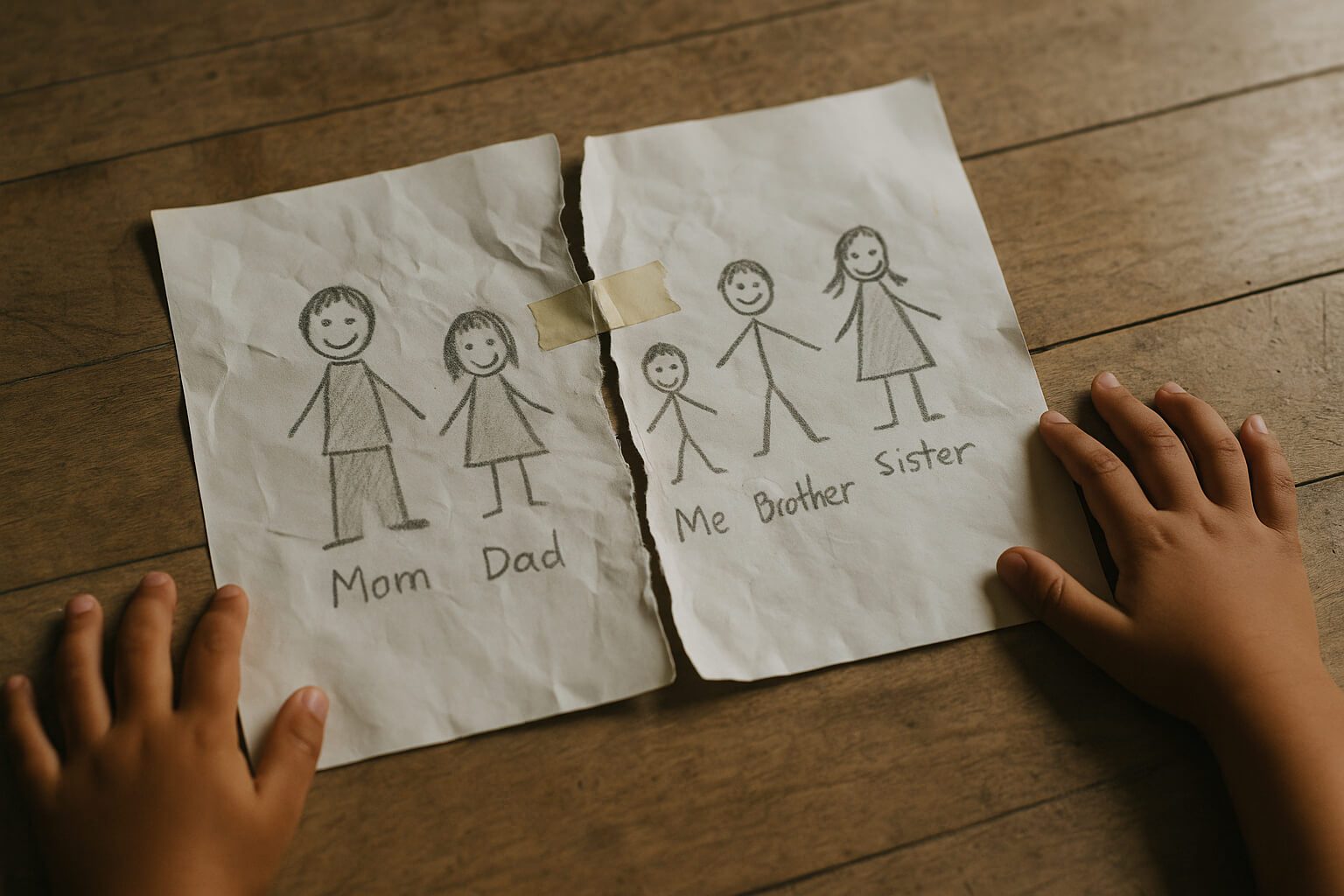
My brothers and sister were placed into foster care. I went back to my grandparents’ house.
They got system meals and sleeping charts. I got hot dinners and my own pillow.
They got caseworkers. I got comfort.
They were treated like numbers. I was treated like someone worth saving.
At the time, I didn’t understand the full weight of it. I just knew we weren’t together anymore. I knew I couldn’t visit them whenever I wanted. I knew things weren’t okay.
And somewhere deep in my gut, even before I had the words for it, I felt the imbalance.
When your family falls apart, the pieces don’t always scatter in fair or equal ways.
We did get to see each other once or twice—supervised visits at neutral places, usually centered around birthdays. I remember my grandma bringing presents, trying her best to patch something together that resembled family. Trying to hold onto normal with wrapping paper and cake.
But nothing about it felt normal. It felt like pretending. Because it was.
Years passed. And slowly, the stories came out.
Not in dramatic confessions. Just fragments. Small moments my brothers dropped into conversations once we were older. Mentions of abuse. Of bullying. Of being afraid in the very places that were supposed to protect them.
I never pried. I just listened.
And every time, something in me cracked again.
Not because I failed them. I was just a kid too.
But because I loved them. And when people you love suffer without you… it wounds you in a way that never fully heals.
That’s what happens when your family falls apart—some scars show up on your body, and some show up in your silence.
And both of them linger.
What This Taught Me About Fatherhood
That season didn’t just mark me—it instructed me.
It taught me what happens when your family falls apart. Not just emotionally, but structurally. When protection disappears and the person who’s supposed to be the shield becomes the reason you need one. When the adult in the house stops being a covering and starts casting a shadow. I didn’t have those words as a kid—but I felt them. Every day.
Now that I’m a father, I carry those memories with me—not as wounds that define me, but as warnings I refuse to ignore. They shaped my definition of fatherhood. They rewrote what “presence” means.
I don’t parent from fear. I don’t try to bubble-wrap my kids. But I’m vigilant. Intentional. Grounded. Because I’ve seen what happens when your family falls apart, and I won’t let that happen under my watch.
Even if it means being the annoying dad who triple-checks doors. Even if it means giving more talks than they want to hear. Even if I sometimes protect too tightly—I’d rather adjust later than regret too late.
My kids don’t need a perfect dad. They need a present one. One who sees them. Covers them. Walks into the hard stuff with them, instead of disappearing when it gets dark.
Because I know what it looks like when survival becomes a child’s only teacher. I know what it feels like to wonder if anyone is actually looking out for you. I lived it. My siblings lived it. My sister suffered the worst of it.
And that’s a classroom I’ll never send my kids into.
Not while I’m breathing.
When Family Is All You Have Left
For a while, we were scattered.
Foster care took my siblings in different directions. I went back to live with my grandparents. We each landed in new routines, surrounded by strangers who didn’t know our story. It was a kind of quiet disconnection—like being in the same song, but on different verses.
And for a time, it felt like our family had fallen apart completely.
But even when your family falls apart, that doesn’t mean it stays broken.
Eventually—thank God—most of us came back together. Not right away. Not without scars. But we found our way back. My sister didn’t return to live with us, but my brothers did. And once we were under the same roof again, that old bond didn’t need rebuilding. It was still there, buried under the rubble, waiting to be lived out again.
Now, when we talk, even after long stretches of silence, it clicks right back into place. The jokes. The rhythms. The shorthand of shared pain and laughter. We don’t have to explain ourselves. We just know.
There’s a kind of love that gets forged in crisis. A loyalty that doesn’t depend on proximity. A connection that doesn’t vanish just because the structure crumbled.
I still slip into big-brother mode sometimes—lecturing, over-explaining, trying to protect. They roll their eyes, but I think they get it. Because we’ve been through too much not to care deeply—even awkwardly.
We didn’t grow up exactly the way we were supposed to.
But we’re still here.
Still choosing each other.
Still family—even after everything.
When Your Family Falls Apart, God Is Still at Work
I didn’t hear God back then.
Didn’t feel held.
Didn’t feel led.
Just heavy. Lost. Alone.
The silence was loud, and the weight felt like mine to carry. I didn’t know how to pray through it—I barely knew how to survive it. When your family falls apart, you don’t always look for God. Sometimes, you just look for the next breath.
But now, all these years later, I can see what He was doing.
He wasn’t shouting over the chaos.
He wasn’t rescuing me from the pain.
He was growing something in the dark.
Endurance, when I wanted to give up.
Compassion, when it would’ve been easier to shut down.
Wisdom, when all I had was instinct.
God didn’t pull me out of the fire.
He built a man in the middle of it.
Not a perfect man. Not even a steady one at the time.
But one who could carry weight—his own, and sometimes the weight of others too.
When your family falls apart, something in you either breaks… or deepens. And the truth is, a lot in me broke. But deeper still, God was shaping me.
That kind of strength doesn’t come from calm.
It comes from chaos. From crisis. From the moments you don’t think you’ll make it—but you do.
I see now that even in the absence, God was present.
He didn’t just spare me.
He shaped me.
So I could be different.
So I could love better.
So I could stop the cycle and build something stronger.
And that…
That’s what makes even the darkest moments sacred.
When Your Family Falls Apart, You Don’t Have to Carry It Alone
If any of this feels familiar—
The silence.
The shame.
The weight you’ve never been able to name…
This part is for you.
Because sometimes, when your family falls apart, you learn to carry things that were never yours. You become the strong one. The quiet one. The one who “turned out fine”—even though you didn’t feel fine at all.
But here’s the truth:
You don’t have to carry what wasn’t yours.
You don’t have to justify your pain.
You don’t have to bury it just because you survived it.
What happened to you—or around you—wasn’t your fault.
But it still shaped you.
And acknowledging that doesn’t make you weak.
It makes you honest.
It makes you human.
You are not broken because you still feel it.
You are not disqualified because you’ve struggled to heal.
You are not alone just because you’ve carried it in silence.
Even when your family falls apart, you are allowed to begin again.
Let the pain speak—but not lead.
Let the past inform—but not imprison.
Let healing happen—but on your terms, one moment at a time.
You’re not too late.
You’re not too damaged.
You’re not the only one.
And you never were.
A Tool for Men Who’ve Been Carrying Too Much, Too Long
Not everything you carried as a boy was yours to carry.
And yet—you did.
Because someone had to.
Because no one else was stepping in.
Because love, in your world, looked a lot like sacrifice.
But now you’re here.
Still standing. Still showing up. Still holding more than most people will ever know.
And maybe, even now, you’re still carrying the fallout from when your family fell apart—even if no one sees it. Even if you’ve never said it out loud.
This devotional isn’t a fix.
It’s not a pitch.
It’s a tool.
A simple, grounded way to start your morning with truth when the lies of shame get loud.
A daily breath for the men who’ve been holding theirs for years.
A small but sacred place where healing can begin—without pressure, without performance.
If you’ve been carrying what no kid should’ve carried, this devotional is for you.
Not because you’re broken.
But because you deserve rest.
You don’t have to keep holding it all by yourself.
You don’t even have to unpack everything at once.
You just have to start.
Start strong.



0 Comments